

Susan Hampshire is one of the most remarkable figures in the entire history of British and American television — a performer whose career spans eight decades, whose dyslexia advocacy changed the lives of millions, whose portrayal of Fleur in the 1967 BBC Forsyte Saga directly inspired the creation of PBS Masterpiece Theatre, and whose return to The Forsytes in 2025 as Lady Carteret — fifty-eight years after she first inhabited Galsworthy’s world — is not merely a career milestone but a living bridge across more than half a century of television history. At 88 years old, she is still working. She is still surprising. And her story is, by any reasonable measure, one of the most extraordinary in the art form she has served since she was ten years old.
Biography / Wiki Table
| Detail | Information |
| Full Name | Susan Hampshire, Lady Kulukundis |
| Date of Birth | May 12, 1937 |
| Age (2025) | 88 years old |
| Place of Birth | Kensington, London, England, UK |
| Nationality | British |
| Ethnicity | White British (Irish descent) |
| Father | George Kenneth Hampshire (ICI director) |
| Mother | June Hampshire (née Pavey; teacher; founded The Hampshire School) |
| Siblings | Two sisters; one brother (youngest of four children) |
| Condition | Dyslexic (diagnosed age 30) |
| School Founded By Mother | The Hampshire School (1928 — now Gems Hampshire School) |
| First Film Appearance | The Woman in the Hall (1947) — age 10 |
| Theatre Training | Assistant Stage Manager, Bognor Regis Repertory |
| West End Debut | Age 18 |
| First Marriage | Pierre Granier-Deferre (French film producer; married 1967; divorced 1974) |
| Son | Christopher Granier-Deferre (film director, actor, producer) |
| Daughter | Died within 24 hours of birth |
| Second Marriage | Sir Eddie Kulukundis (theatre impresario, shipping magnate; married April 4, 1981; died 2021) |
| Honours | OBE (1995 — services to dyslexic people); CBE (2018 — services to drama and charity) |
| Emmy Wins | 3 — The Forsyte Saga (1970), The First Churchills (1971), Vanity Fair (1973) |
| Dyslexia Roles | President, Dyslexia Institute (1995–1998); patron of multiple charities |
| Books | Susan’s Story (1981 — autobiography/dyslexia memoir); children’s Lucy Jane series; gardening books; The Maternal Instinct (1985) |
| Defining TV Roles | Fleur — The Forsyte Saga (BBC, 1967); Sarah Churchill — The First Churchills (BBC, 1969); Becky Sharp — Vanity Fair (BBC, 1967/US 1972); Glencora Palliser — The Pallisers (BBC, 1974); Molly MacDonald — Monarch of the Glen (BBC, 2000–2005) |
| The Forsytes 2025 Role | Lady Carteret — The Forsytes (Channel 5 / PBS Masterpiece, 2025) |
| Net Worth (est.) | Approximately £3–5 million |
| IMDb | nm0358925 |
Early Life: Kensington, Dyslexia Undiagnosed, and a Mother Who Built a School
Susan Hampshire was born on May 12, 1937, in Kensington — one of London’s most elegant and historically significant Royal Boroughs, set in the heart of west London between Hyde Park and the Thames. She was the youngest of four children born to George Kenneth Hampshire, a director at Imperial Chemical Industries who was rarely at home and whose unofficial separation from the family left their mother June to manage the household largely alone, and June Hampshire herself — a woman of considerable energy and determination who responded to the educational challenges she observed in her children by founding a small London school in 1928, The Hampshire School, which today operates as Gems Hampshire School.
The fact that Susan Hampshire’s mother founded a school is not incidental biographical detail. It is the origin story of everything that would eventually make her daughter one of the most significant public advocates for dyslexia and learning difference in British history. June Hampshire understood, from her children’s experiences, that the standard educational approaches of the time were failing children whose learning differences were not recognised or accommodated — and she did something about it. The daughter would spend decades doing the same, on a far larger public stage.
As a child, Susan Hampshire could not spell her own name until she was nine years old. She could not read well until she was twelve. She struggled through a standard school curriculum that had no language for what she was experiencing and no mechanism for supporting her through it — only the assumption, common to the era, that difficulty with reading and spelling reflected limited intelligence or insufficient effort. She was not unintelligent. She was dyslexic. But she would not know that until she was thirty years old.
Her childhood ambition was to be a nurse — a vocation whose combination of care, discipline, and practical service suited her temperament entirely. But the O-Level examination in Latin that nursing required proved impossible to pass, and the ambition that could not find that particular outlet eventually found another. She decided to become an actress.
Theatre Training: Bognor Regis, the West End, and the Stage Foundation
The training that would underpin everything Susan Hampshire achieved on screen began in the theatre — specifically at the Bognor Regis repertory company, where she worked as an Assistant Stage Manager while simultaneously learning the craft of acting in the most practical possible environment. Repertory theatre in Britain has historically been one of the most effective training grounds available to young performers: the demands of rotating through multiple productions rapidly, playing a variety of roles across different genres, and doing so with the limited rehearsal time that repertory schedules allow develop professional discipline and versatility at a speed that drama school alone cannot match.
She made her West End debut at the age of eighteen — a significant achievement for a young performer who had not attended a formal drama conservatory, and one that speaks to the quality of the foundation the Bognor Regis experience had given her. The film record shows her first screen appearance at the age of ten — a walk-on in The Woman in the Hall (1947) — but her serious professional career as a screen actress began in the late 1950s, with her appearance as a debutante in Expresso Bongo (1959), the musical comedy film based on the West End show that starred Laurence Harvey and Cliff Richard.
Walt Disney and the 1960s Film Career
The 1960s brought Susan Hampshire a film career of genuine international scope and variety — a decade in which she worked across British, French, and American productions and established herself as one of the most versatile and appealing British actresses of her generation.
Walt Disney signed her to star in The Three Lives of Thomasina (1963) — a family film about a Scottish veterinarian whose daughter’s healing of a magical cat brings a mysterious woman into their lives. Disney’s personal decision to cast her spoke to the specific quality of warmth and natural charm that Hampshire projected, and the film’s family audience gave her an American profile that purely theatrical or art film credits could not have provided.
Her subsequent film work ranged widely: Night Must Fall (1964) with Albert Finney; Wonderful Life (1964) alongside Cliff Richard; The Fighting Prince of Donegal (1966); Paris in the Month of August (1966) — a Franco-British co-production directed by Pierre Granier-Deferre, whose casting her in the lead role initiated the relationship that would eventually become their 1967 marriage; Living Free (1972), the sequel to Born Free, in which she played conservationist Joy Adamson opposite the lioness Elsa.
| Notable 1960s–70s Films | Year | Notes |
| The Woman in the Hall | 1947 | First screen appearance (age 10) |
| Expresso Bongo | 1959 | Proper professional debut |
| The Long Shadow | 1961 | — |
| The Three Lives of Thomasina | 1963 | Walt Disney; family film |
| Night Must Fall | 1964 | Albert Finney |
| Wonderful Life | 1964 | Cliff Richard |
| The Fighting Prince of Donegal | 1966 | Disney historical |
| The Trygon Factor | 1966 | Crime thriller |
| The Violent Enemy | 1967 | Political thriller |
| Paris in the Month of August | 1966 | Pierre Granier-Deferre (director/future husband) |
| Malpertuis | 1971 | Belgian horror film; Orson Welles |
| Living Free | 1972 | Joy Adamson; sequel to Born Free |
| Neither the Sea Nor the Sand | 1972 | — |
| Dr. Jekyll and Mr. Hyde | 1973 | TV film |
| Bang! | 1977 | — |
The Malpertuis credit — the 1971 Belgian Gothic horror film directed by Harry Kümel and also starring Orson Welles — is one of the more unexpected credits in Hampshire’s filmography, and one that speaks to a performer willing to take creative risks and work with European cinema at a distance from the mainstream British film world.
The Forsyte Saga (1967): The Role That Made Her, the Show That Made PBS
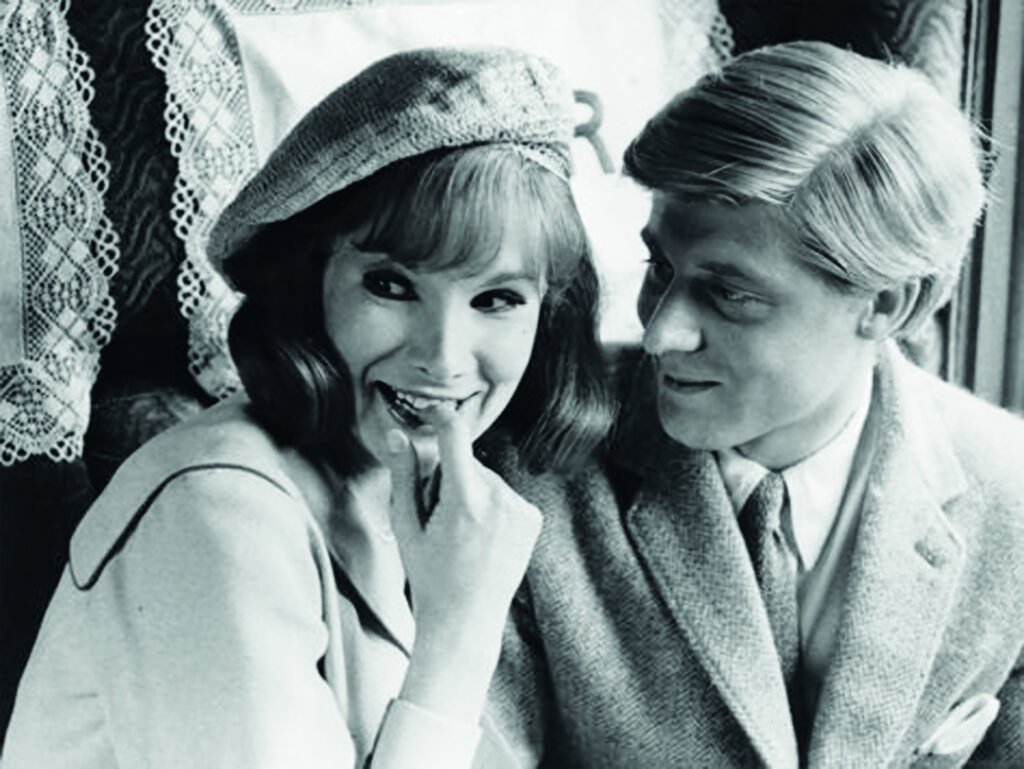
The television role that transformed Susan Hampshire from a well-regarded British actress into an international television star of the first magnitude was Fleur Forsyte in the BBC’s 26-part adaptation of John Galsworthy’s The Forsyte Saga — a production that first aired on BBC Two in 1967 and was subsequently broadcast on American public television from 1969 to 1970, where it became a cultural phenomenon of extraordinary proportion.
The Forsyte Saga was, in Britain, the production that effectively killed Sunday evening church attendance for the duration of its run — a hyperbolic claim that nonetheless captures something real about the grip it had on the national imagination. The BBC shot it in black and white, which was already something of an artistic statement in 1967, and the 26-episode scope of the adaptation gave it the space to inhabit Galsworthy’s complex family saga with genuine fidelity to the novels’ moral and emotional architecture.
Hampshire played Fleur — a character whose arc spans the saga’s later sections, and whose passionate nature, frustrated ambitions, and complex relationship with her own family history gave Hampshire the full range of what she was capable of. The performance is considered one of the great characterisations in British television drama history, and it earned her the first of her three Emmy Awards in 1970 — the American Television Academy’s formal recognition that her work was, by any international standard, exceptional.
But the significance of The Forsyte Saga goes considerably beyond its awards and its viewing figures. Its extraordinary popularity on American public television directly inspired the creation of Masterpiece Theatre — the PBS anthology series launched in 1971 that became the defining institution of quality British drama on American television and that still exists today as PBS Masterpiece, the very platform on which The Forsytes (2025) would air nearly six decades later. The causal chain from Hampshire’s performance in 1967 to the creation of an institution that has broadcast thousands of hours of quality television to American audiences over five decades is not a coincidence of programming. It is a direct legacy.
Three Emmy Awards: The First Churchills and Vanity Fair
The Emmy Award for The Forsyte Saga in 1970 was only the beginning of what became, in the following three years, one of the most sustained records of international television recognition in the history of the medium.
In 1969, the BBC produced The First Churchills — a 12-part historical drama about John Churchill, first Duke of Marlborough, and his formidable wife Sarah — with Hampshire in the lead role of Sarah Churchill, one of the most influential women in British political history. The First Churchills was the very first series offered on the newly launched Masterpiece Theatre in 1971, and Hampshire’s Sarah Churchill won her second Emmy Award — meaning that her work had been directly responsible for inspiring the creation of Masterpiece Theatre and had simultaneously provided its inaugural broadcast.
The third Emmy came in 1973 for Becky Sharp in Vanity Fair — the BBC adaptation of William Makepeace Thackeray’s novel, originally broadcast in the UK in 1967 and subsequently shown on PBS in 1972. Becky Sharp is one of the great anti-heroines of English literature — witty, amoral, brilliant, manipulative, irresistibly vital — and Hampshire’s portrayal of her was by the consensus of American critics the finest the character had received on screen to that point.
| Emmy Award | Role | Production | Year Won |
| Win #1 — Outstanding Lead Actress in a Drama Series | Fleur Forsyte | The Forsyte Saga (BBC, 1967) | 1970 |
| Win #2 — Outstanding Lead Actress in a Limited Series | Sarah Churchill | The First Churchills (BBC, 1969) | 1971 |
| Win #3 — Outstanding Lead Actress in a Drama Series | Becky Sharp | Vanity Fair (BBC, 1967/PBS 1972) | 1973 |
Three Emmy Awards across three consecutive years, for three completely different roles in three different literary adaptations, is a record that speaks not merely to talent but to a specific and extraordinary quality of sustained, versatile excellence that the American television industry — whose Emmy voters were, in this period, encountering the best of British public television drama for the first time — recognised with unusual consistency.
The Pallisers, David Copperfield, and the PBS Era
Susan Hampshire’s relationship with PBS and American public television extended well beyond The Forsyte Saga, The First Churchills, and Vanity Fair. In 1970, she was remembered as Agnes Wickfield in the NBC adaptation of David Copperfield — Charles Dickens’s most autobiographical novel — a performance that reached American network television rather than solely the public broadcasting audience.
In 1974, she played Glencora Palliser — the spirited, politically engaged wife of the future British Prime Minister Plantagenet Palliser — in The Pallisers, Simon Raven’s 26-part BBC adaptation of Anthony Trollope’s six-novel Palliser series. The Pallisers was another of the grand BBC literary adaptations of the 1970s that defined both what British public television could achieve and what PBS Masterpiece would broadcast to American audiences, and Hampshire’s Glencora was considered by many critics the finest thing in the production.
The sheer volume and quality of the major literary adaptations in which Hampshire appeared across the 1960s and 1970s — Galsworthy, Thackeray, Dickens, Trollope — gives her career a literary pedigree that very few screen performers of any era can match.
Dyslexia: The Advocacy That Changed Millions of Lives
When Susan Hampshire was diagnosed with dyslexia at the age of thirty — in the late 1960s, when she was already one of Britain’s most recognisable television actresses — it explained everything that had been unexplained about her childhood struggles. The inability to spell her name at nine. The difficulty with reading until twelve. The failed Latin O-Level that had prevented the nursing career she wanted. All of it crystallised into something comprehensible and, more importantly, something she could act upon.
She wrote her autobiography, Susan’s Story, in 1981 — a book whose frank and detailed account of living with an undiagnosed learning difference for thirty years was, at the time of its publication, a significant act of public courage. Before Susan’s Story, dyslexia was widely misunderstood by the British public, frequently dismissed as an excuse for laziness or limited intelligence, and largely invisible in the public conversation about education and learning. After it, the conversation changed.
She served as President of the Dyslexia Institute from 1995 to 1998 — the period during which she was appointed OBE in the 1995 Birthday Honours specifically for her services to dyslexic people, a recognition that formally acknowledged the scope and significance of what her advocacy had achieved. She also became a patron of charities supporting people with AIDS, osteoporosis, diabetes, and disabled children’s access to theatre — a breadth of charitable commitment that reflects someone who understood her public profile as a resource to be used in service of others.
The CBE awarded in the 2018 New Year Honours for services to drama and charity acknowledged both the professional and the public dimensions of a career whose scope had always extended well beyond the screen.
Her book The Maternal Instinct (1985) addressed her experience of the death of her infant daughter within 24 hours of her birth — a devastating personal loss written about with the same honesty and directness that characterised everything she brought to her public advocacy.
She also wrote the Lucy Jane series of children’s books and several gardening books during the 1980s, a period during which her performing career was largely dormant as she devoted herself to writing and to charitable work.
Monarch of the Glen: Five Series, One Beloved Character
After the relative dormancy of the 1980s and a theatrical and television return in the 1990s, Susan Hampshire found her next great sustained television role in Monarch of the Glen — the BBC One drama series about a young Londoner who inherits a crumbling Highland estate and must decide whether to sell it or save it. She played Molly MacDonald — the warm-hearted, determinedly interfering local woman whose connection to the estate and its community provides much of the show’s emotional heart — across five series from 2000 to 2005.
Monarch of the Glen was one of BBC One’s most popular drama series of its period, reaching an audience considerably larger than the devoted PBS Masterpiece viewers who had followed Hampshire’s career since The Forsyte Saga, and introducing her work to a new generation of British viewers for whom Fleur Forsyte and Glencora Palliser were historical television memories rather than lived viewing experiences. It generated genuine national affection — she recalled with delight that children under ten at local fetes called her Molly rather than Susan, and that some called her “Susan Hamster,” which she described as sweet rather than offensive.
The Grand, Barchester Chronicles, and a Complete Television Record
The television record of Susan Hampshire across seven decades of professional work is one of the most extensive and most varied in British broadcasting history.
| Key Television Productions | Year | Role | Network |
| What Katy Did | 1962 | Katy | BBC |
| The Forsyte Saga | 1967 | Fleur Forsyte | BBC (Emmy Win 1970) |
| The First Churchills | 1969 | Sarah Churchill | BBC (Emmy Win 1971) |
| Vanity Fair | 1967 (UK) / 1972 (US) | Becky Sharp | BBC (Emmy Win 1973) |
| David Copperfield | 1970 | Agnes Wickfield | NBC |
| The Pallisers | 1974 | Glencora Palliser | BBC |
| The Barchester Chronicles | 1982 | Mrs. Proudie | BBC |
| The Grand | 1997–1998 | Sarah Harvey | ITV |
| Monarch of the Glen | 2000–2005 | Molly MacDonald | BBC One |
| Midsomer Murders | 2007 | Delphi Hartley | ITV |
| The Forsytes (2025) | 2025 | Lady Carteret | Channel 5 / PBS Masterpiece |
The Barchester Chronicles (1982) — the BBC adaptation of Anthony Trollope’s Barchester novels, one of the most beloved adaptations in BBC history — cast her as Mrs. Proudie, the formidable, overbearing wife of the Bishop of Barchester, one of Trollope’s great comic-dramatic creations. The Grand (1997–1998) — the ITV period drama set in a Manchester hotel in the 1920s, created by Russell T Davies — gave her a sustained recurring role in a production that was ambitious in both its social scope and its willingness to engage with the political and moral tensions of the interwar period.
Marriage, Loss, and the Shape of a Personal Life
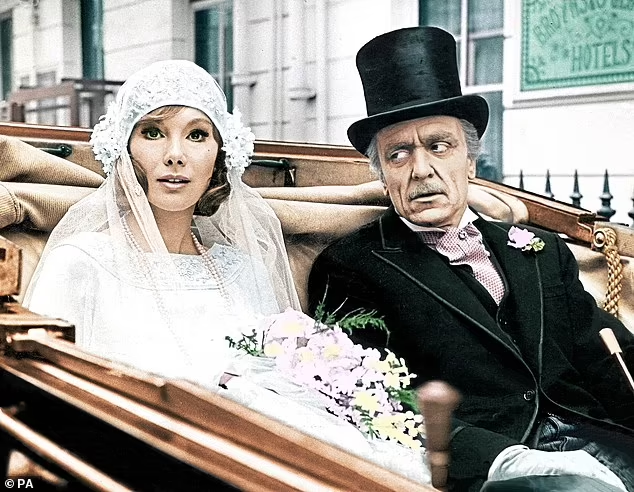
Susan Hampshire’s personal life has been marked by both great love and significant grief. Her first marriage to Pierre Granier-Deferre — the French film director who cast her in Paris in the Month of August — produced a son, Christopher, who has followed her into the film world as a director, actor, and producer, and a daughter who died within 24 hours of her birth — a loss Hampshire wrote about with extraordinary honesty and without false resolution in The Maternal Instinct in 1985.
Her second marriage to Sir Eddie Kulukundis — the theatre impresario, shipping magnate, and sport philanthropist who was one of the most significant figures in British theatre of his era — began on April 4, 1981, and lasted until his death in 2021. In 2009, she had contemplated stepping back from her professional life to care for him as his health declined with dementia and type 2 diabetes — a consideration that speaks to the depth of her commitment to the personal dimension of her life alongside the professional one. She became Lady Kulukundis upon her marriage to Sir Eddie, the formal title she carries today.
The Forsytes (2025): Lady Carteret and the Return After 58 Years
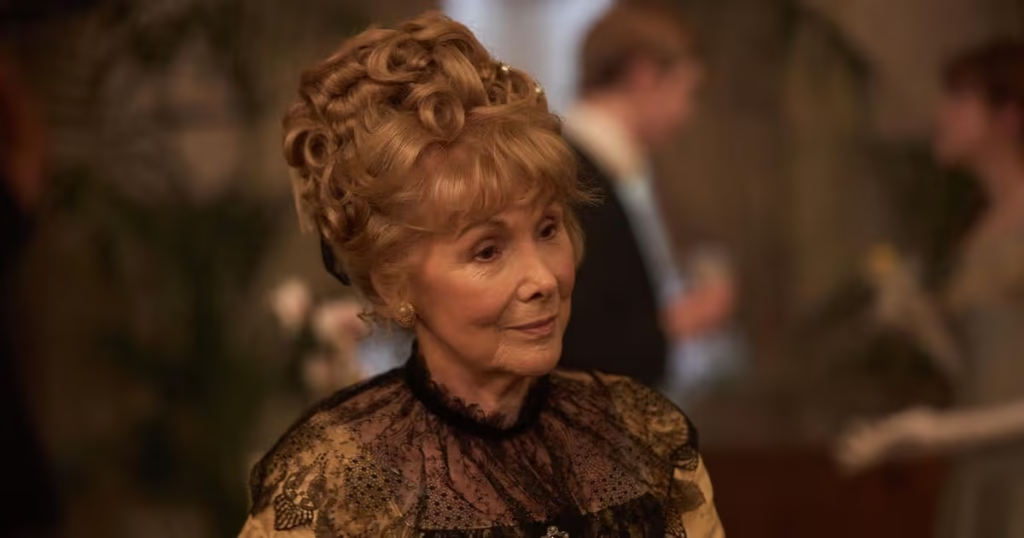
The most extraordinary biographical fact in the career of Susan Hampshire is this: fifty-eight years after she played Fleur Forsyte in the BBC’s landmark 1967 adaptation of The Forsyte Saga — the production that helped inspire the creation of PBS Masterpiece Theatre and earned her the first of her three Emmy Awards — she returned to The Forsytes in 2025, playing Lady Carteret in Channel 5 and PBS Masterpiece’s new adaptation of Galsworthy’s novels.
She is the only performer in the world who could be in both productions. She is the living bridge between the version of this story that defined British Sunday evening television for an entire generation and the version now introducing the saga to a new audience in 2025 and 2026. Her presence in the cast is not a casting gimmick or a nostalgic gesture — it is a meaningful artistic decision, an acknowledgement that the new production exists in conscious relationship with the legacy of the original, and that the most powerful way to honour that relationship is to have the person who embodied it present in the room.
The Forsytes premiered on Channel 5 in the United Kingdom on October 20, 2025, and is scheduled for its American premiere on PBS Masterpiece on March 22, 2026 — the same platform whose very existence her 1967 performance directly inspired. A second season was commissioned before the first had even aired.
She joined a cast of extraordinary distinction — Stephen Moyer, Tuppence Middleton, Joshua Orpin, Millie Gibson, Eleanor Tomlinson, Jack Davenport, Jamie Flatters, Tom Durant-Pritchard, Danny Griffin, Josette Simon OBE, and Francesca Annis — bringing to it not just her own extraordinary talent but the specific weight of fifty-eight years of Forsyte history.
At 88 years old, Susan Hampshire is still working. Still bringing precision and authority and the warmth of genuine experience to every scene she is in. Still the most interesting person in any room she enters, the way she always has been.
The Woman Who Helped Create PBS — and Then Came Back
The career of Susan Hampshire is not merely a career. It is a contribution — to British theatre and television, to American public broadcasting, to the understanding and acceptance of dyslexia as a learning difference rather than a deficiency, to the literature-to-screen tradition that has been one of British television’s greatest gifts to the world.
She helped create PBS through the quality of her work. She told the truth about her own learning difference at a time when doing so required genuine courage. She wrote about the death of her daughter with the same honesty. She spent decades in charitable advocacy without ever converting it into a promotional talking point. And she did all of this while maintaining one of the most varied and most consistently excellent screen careers in the history of the medium.
In 2025, at 88, she walked back into The Forsytes — the world that made her, the world that she helped make famous — and did what she has always done: showed up, fully present, completely committed, and better than anyone had any right to expect.
Career Timeline
| Year | Milestone |
| May 12, 1937 | Born in Kensington, London — youngest of four children |
| ~1945–1950 | Struggles with reading and spelling; undiagnosed dyslexia |
| 1947 | First film appearance in The Woman in the Hall (age 10) |
| ~Early 1950s | Theatre training begins; Assistant Stage Manager at Bognor Regis Repertory |
| ~1955 | West End debut (age 18) |
| 1959 | Professional film debut in Expresso Bongo (with Laurence Harvey) |
| 1962 | Lead role in What Katy Did (BBC television) |
| 1963 | Walt Disney’s The Three Lives of Thomasina |
| 1964 | Night Must Fall (Albert Finney); Wonderful Life (Cliff Richard) |
| 1966 | Paris in the Month of August — meets future husband Pierre Granier-Deferre |
| 1967 | Fleur Forsyte — The Forsyte Saga (BBC 26-part serial); marries Pierre Granier-Deferre |
| ~1967 | Diagnosed as dyslexic at age 30 |
| 1967 | Becky Sharp — Vanity Fair (BBC) |
| ~1968 | Daughter born; dies within 24 hours |
| 1969 | Sarah Churchill — The First Churchills (BBC) — becomes first Masterpiece Theatre broadcast in 1971 |
| 1970 | Emmy Win #1 — The Forsyte Saga |
| 1970 | Agnes Wickfield — David Copperfield (NBC) |
| 1971 | Emmy Win #2 — The First Churchills |
| 1972 | Joy Adamson — Living Free (film) |
| 1973 | Emmy Win #3 — Vanity Fair; Dr. Jekyll and Mr. Hyde (TV) |
| 1974 | Glencora Palliser — The Pallisers (BBC); divorces Pierre Granier-Deferre; plays Peter Pan |
| 1974 | Rosalind in As You Like It; Katherina in Taming of the Shrew (Shaw Theatre) |
| 1977 | Bang! (film) |
| 1980s | Largely withdraws from performing; writes Susan’s Story (1981), children’s books, The Maternal Instinct (1985) |
| April 4, 1981 | Marries Sir Eddie Kulukundis |
| 1982 | Mrs. Proudie — The Barchester Chronicles (BBC) |
| 1990 | Returns to theatre in A Little Night Music |
| 1993 | Savoy Theatre — Relative Values |
| 1995 | Appointed OBE for services to dyslexic people |
| 1995–1998 | President of the Dyslexia Institute |
| 1997–1998 | Sarah Harvey — The Grand (ITV) |
| 2000–2005 | Molly MacDonald — Monarch of the Glen (BBC One) — 5 series |
| 2007 | Midsomer Murders guest appearance |
| 2008 | Chichester Festival Theatre — The Circle (Somerset Maugham) |
| 2009 | Considers stepping back to care for Sir Eddie (dementia and diabetes) |
| 2018 | Appointed CBE for services to drama and charity |
| 2021 | Sir Eddie Kulukundis dies |
| 2025 | Lady Carteret — The Forsytes (Channel 5 / PBS Masterpiece) — returning to Forsyte world 58 years after original |
| October 20, 2025 | The Forsytes premieres on Channel 5, UK |
| March 22, 2026 | The Forsytes premieres on PBS Masterpiece, USA — the institution her 1967 work helped create |