
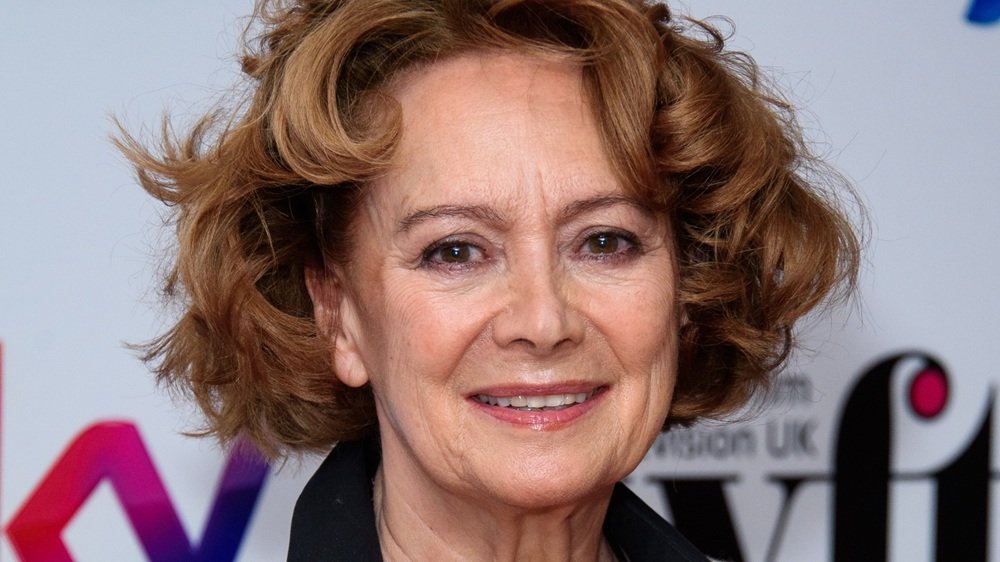
There are actresses who accumulate credits, and then there are actresses who accumulate gravitas. Francesca Annis belongs emphatically to the second category. Born the week Europe celebrated the end of World War II, she has spent eight decades on this earth and more than seven of them in front of an audience — on stage, on screen, and in the public imagination. She has played queens and mistresses, heroines and aristocrats, women of passion and women of iron restraint, and she has brought to each of them something that cannot be taught: the quality of a life richly and unsparingly lived, pressing through every performance.
Biography at a Glance
| Detail | Information |
| Full Name | Francesca Maria Annis |
| Date of Birth | 14 May 1945 |
| Place of Birth | Kensington, London, England |
| Early Childhood | Brazil (ages 1–7) |
| Education | Corona Theatre School, London |
| Nationality | British |
| Father | Lester William Anthony Annis (actor, 1914–2001) |
| Mother | Mariquita “Mara” Purcell (actress and blues singer, 1913–2009) |
| Siblings | Two brothers: Quenton and Tony |
| Long-term Partners | Patrick Wiseman (1974–1997); Ralph Fiennes (1995–2006) |
| Children | Charlotte Wiseman, Taran Wiseman, Andreas Wiseman |
| Occupation | Actress |
| Active Since | 1959 |
| BAFTA Wins | 1 (Best Actress, Lillie, 1979) |
| BAFTA Nominations | 6 |
Copacabana to Kensington: An Unconventional Beginning
The life of Francesca Annis does not begin in the expected place. Although she was born in Kensington, London, in May 1945 — six days after V-E Day — she spent the first seven years of her childhood in Brazil, where her parents had relocated when she was barely a year old. Her father Lester was an English actor; her mother Mara, of Brazilian-French heritage, was a former actress who reinvented herself in South America as a blues singer. The family ran a nightclub on Copacabana beach. Portuguese was the only language young Francesca spoke until she returned to England at the age of seven — a childhood so vivid and so far outside the ordinary British experience that it seems almost scripted.
Back in England, she was educated at a convent school, where she briefly considered a vocation in the Church before being pulled, as she has put it, toward movement and performance instead. She trained first as a ballet dancer — in the Russian style, at the Corona Theatre School — before the stage claimed her entirely. The Corona, which had previously trained many notable British performers, gave her a technical foundation she would carry for the rest of her career. By her early teens, she was already working professionally.
Her film debut came in 1959, in the family crime picture The Cat Gang. She was fourteen. Four years later, she was standing on the set of Joseph L. Mankiewicz’s Cleopatra as a handmaiden to Elizabeth Taylor — one of the most lavish and discussed productions in Hollywood history. It was not a speaking role that would change the world, but it was an education in scale, in spectacle, and in how the very biggest films were made.
The 1960s: London, Ophelia, and a Fashionable Radicalism
The decade that followed her Cleopatra appearance was one of considerable personal and professional formation. Francesca Annis moved through London’s cultural scene as it shifted into the extraordinary social ferment of the mid-1960s, and she was not merely a bystander. She marched. She picketed the Miss World contest. She cut her hair short. She turned down films that did not interest her — a habit she would maintain throughout her career. Her social circle was wide and unconventional, touching the edges of the music world and the visual arts as much as the theatre.
On stage, the significant moment came in 1969 when she was cast as Ophelia opposite Nicol Williamson’s Hamlet, directed by Tony Richardson, first in London at the Roundhouse and then on Broadway. The production was intense, unconventional, and critically debated — but Annis’s Ophelia established her as a performer of real classical capability. She was 24, and she had played Shakespeare on Broadway. The decade had delivered on its promise.
Her television work in the 1960s also built steadily, including the role of Estella in a 1967 BBC adaptation of Great Expectations, playing a character whose combination of beauty and emotional withholding would prove to be something of a recurring Annis signature.
Macbeth, Lillie, and the Making of a BAFTA Winner
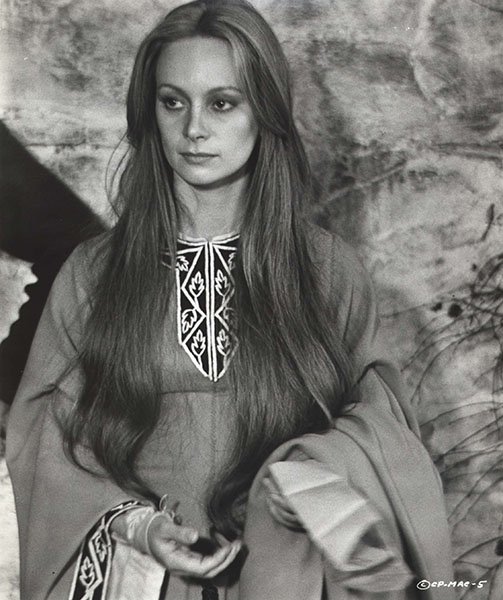
The 1970s were the decade that confirmed Francesca Annis as a serious and consequential actress. The first major landmark was Roman Polanski’s 1971 film version of Macbeth — a dark, visceral, and deliberately brutal adaptation that remains one of the more contested Shakespeare films of the twentieth century. Annis played Lady Macbeth, and the sleepwalking scene — performed in the nude, a choice that generated enormous press attention at the time — was understood by most critics as an artistic decision that served the psychological exposure the scene demanded. Hugh Hefner, one of the film’s backers, subsequently asked her to pose for Playboy. Her response has since become one of the better-known quotations in her biographical record: “I’m an actress, not a pinup.” The offer was declined.
The RSC years followed. From 1975 to 1978, Annis was a member of the Royal Shakespeare Company, playing Luciana in Trevor Nunn’s celebrated musical production of The Comedy of Errors and Juliet opposite Ian McKellen in Romeo and Juliet. These were prestige assignments at the most prestigious company in English theatre.
Alongside her stage work, she was building a parallel reputation in television. She first played the Victorian beauty and socialite Lillie Langtry in the 1975 ATV serial Edward the Seventh, and she reprised the role in the thirteen-episode ITV series Lillie in 1978. The second series covered the full arc of Langtry’s extraordinary life — from ingenue to stage actress to enduring public figure — and required Annis to age the character across six decades of dramatised existence. It was work of sustained, technically demanding commitment. In 1979 it won her the BAFTA TV Award for Best Actress, the only competitive BAFTA of her career to date, though she would be nominated five more times.
| Year | Project | Role | Type | Award |
| 1959 | The Cat Gang | Supporting | Film | — |
| 1963 | Cleopatra | Handmaiden | Film | — |
| 1969 | Hamlet (stage/Broadway) | Ophelia | Theatre | — |
| 1971 | Macbeth | Lady Macbeth | Film | — |
| 1975 | Edward the Seventh | Lillie Langtry | Television | — |
| 1976 | The Comedy of Errors (RSC) | Luciana | Theatre | — |
| 1976 | Romeo and Juliet (RSC) | Juliet | Theatre | — |
| 1975 | Madame Bovary | Emma Bovary | Television | BAFTA Nom. |
| 1978 | Lillie | Lillie Langtry | Television | BAFTA Win |
| 1983 | Krull | Widow of the Web | Film | — |
| 1983 | The Secret Adversary | Tuppence Beresford | Television | — |
| 1983–84 | Agatha Christie’s Partners in Crime | Tuppence Beresford | Television | — |
| 1984 | Dune | Lady Jessica | Film | — |
| 1986 | Under the Cherry Moon | Mrs Wellington | Film | — |
| 1988 | Onassis: The Richest Man in the World | Jacqueline Kennedy | Television | — |
| 1991 | Parnell and the Englishwoman | Kitty O’Shea | Television | — |
| 1993–94 | Between the Lines | Patricia Cheng | Television | — |
| 1995 | Hamlet (Almeida/Broadway) | Queen Gertrude | Theatre | — |
| 1998 | Reckless | Anna Fairley | Television | BAFTA Nom. |
| 1999 | Wives and Daughters | Hyacinth Gibson | Television | BAFTA Nom. |
| 2000 | Deceit | Lead | Television | BAFTA Nom. |
| 2004 | The Libertine | Lady Rochester | Film | — |
| 2007 | Cranford | Lady Ludlow | Television | — |
| 2015–16 | Home Fires | Frances | Television | — |
| 2019 | Flesh and Blood | Vivien | Television | — |
| 2025 | The Forsytes | Ann Forsyte | Television | — |
The 1980s and 1990s: Dune, Agatha Christie, and Art Imitating Life
The 1980s brought Francesca Annis two science fiction roles of very different register. In 1983 she appeared in the fantasy epic Krull as the Widow of the Web — a scene-stealing supporting turn in a film that has acquired considerable cult affection over the decades. In 1984 she played Lady Jessica in David Lynch’s adaptation of Frank Herbert’s Dune, opposite Kyle MacLachlan. The film was a critical disappointment at the time and remains one of Lynch’s most complicated legacies, but Annis’s Lady Jessica — a woman of deep spiritual power, suppressed grief, and quiet ferocity — was one of its genuinely distinguished elements.
Television in this period brought her the role she is perhaps most warmly associated with among a particular generation of PBS viewers: Tuppence Beresford in Agatha Christie’s Partners in Crime (1983–84), a witty and warmly performed series opposite James Warwick. It was popular, light-hearted, and enormously loved.
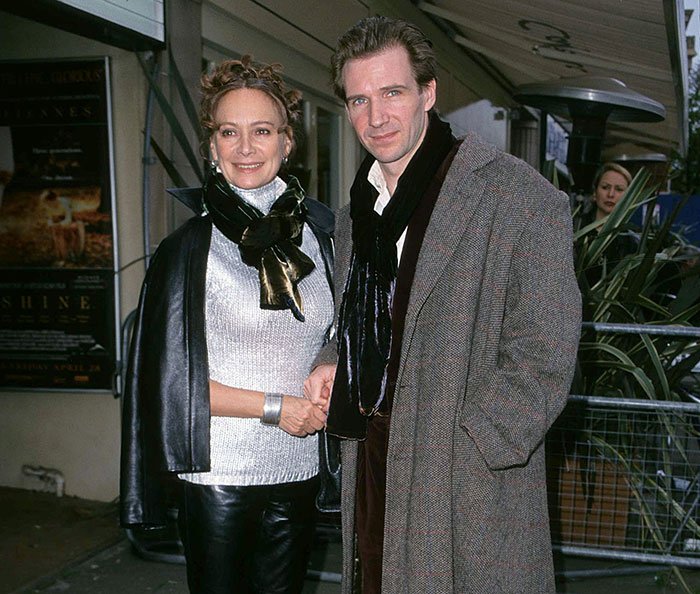
Then came 1995, and Hamlet. She played Queen Gertrude to Ralph Fiennes’ Danish prince at the Almeida Theatre in London and then on Broadway — a production that was critically acclaimed and personally transformative. The professional relationship between the two actors became a romantic one, and the relationship became publicly known when Fiennes separated from his wife, Alex Kingston, in 1997. Annis herself ended her long partnership with photographer Patrick Wiseman, the father of her three children, with whom she had been for over twenty years. The tabloid interest was intense — the age difference between her and Fiennes was approximately eighteen years, with Annis the elder — and their relationship remained a subject of public fascination throughout the eleven years it lasted.
Her television work in the late 1990s addressed that fascination almost directly. In the 1998 ITV drama Reckless, she played Anna Fairley, a woman on the precipice of infidelity with a younger man. Critics were not slow to note the parallel. She earned a BAFTA nomination. The following year she appeared in the BBC adaptation of Wives and Daughters as the social-climbing Hyacinth Gibson, earning another nomination. In 2000 she appeared in Deceit, earning a sixth.
The 2000s: Separation, Stage, and Sustained Excellence
The relationship with Ralph Fiennes ended in February 2006, following his widely reported involvement with a Romanian singer. A brief, concise statement from Annis’s spokesperson confirmed the separation. She said little about it publicly, and has maintained that reticence since — a discretion consistent with a woman who has always protected the private dimension of a very public life.
What followed was a return to the work. She appeared alongside Johnny Depp in the 2004 period drama The Libertine as Lady Rochester. She continued to work in theatre. In 2007 she appeared in the BBC’s beloved ensemble drama Cranford, playing Lady Ludlow — an aristocrat who opposes the education of the lower classes — alongside Michael Gambon and Judi Dench. From 2015 to 2016 she played Frances in the ITV wartime drama Home Fires, set in a Cheshire village during the Second World War. In 2019 she led the Channel 4 psychological thriller Flesh and Blood as Vivien, a widow whose new relationship with a charismatic stranger creates alarmed ripples through her adult children. It was quietly unsettling work that reminded anyone who needed reminding of her capacity to inhabit complexity.
Awards and Recognition
| Year | Award | Category | Result |
| 1974 | BAFTA TV Award | Best Actress (A Pin to See the Peepshow) | Nominated |
| 1976 | BAFTA TV Award | Best Actress (Madame Bovary) | Nominated |
| 1977 | Laurence Olivier Award | Best Actress in a Revival (Troilus and Cressida) | Nominated |
| 1978 | Variety Club Award | ITV Personality of the Year | Won |
| 1979 | BAFTA TV Award | Best Actress (Lillie) | Won |
| 1998 | BAFTA TV Award | Best Actress (Reckless) | Nominated |
| 1999 | BAFTA TV Award | Best Actress (Wives and Daughters) | Nominated |
| 2000 | BAFTA TV Award | Best Actress (Deceit) | Nominated |
The Forsytes: The Matriarch at the Summit
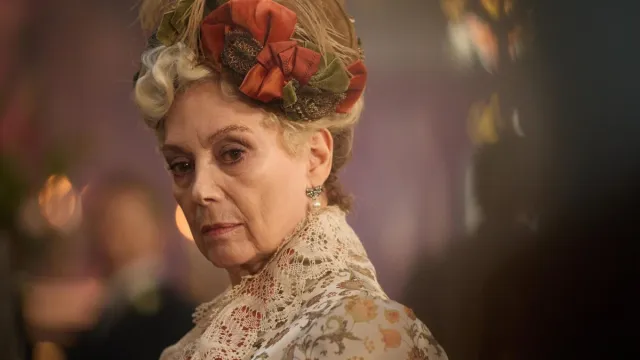
In 2025, Francesca Annis took on the role that sits at the very apex of the ensemble she has joined: Ann Forsyte, the formidable matriarch at the heart of The Forsytes, the Channel 5 and PBS Masterpiece reimagining of John Galsworthy’s Nobel Prize-winning novels. The series, written by Debbie Horsfield — the writer behind Poldark — and directed by Meenu Gaur and Annetta Laufer, premiered in the UK on 20 October 2025, with a PBS Masterpiece premiere scheduled for 22 March 2026.
Ann Forsyte is the woman around whom the entire dynastic drama orbits. Mother to the two feuding sons at the story’s centre — Jolyon Senior (Stephen Moyer) and the resentful James (Jack Davenport) — she is the keeper of the family’s values, its dignity, and its secrets. The ensemble around her is formidable: Eleanor Tomlinson, Tuppence Middleton, Millie Gibson, and others. But the gravitational pull of the piece runs through Ann, and it runs through Annis. The production had been renewed for a second series before a single episode had aired — a testament not only to broadcaster confidence in the project but to what the casting of its centrepiece promised.
At eighty years of age, playing a Victorian matriarch who commands every room she enters, Annis is doing what she has always done: making it look effortless.
Career Timeline
| Year | Milestone |
| 1945 | Born in Kensington, London, six days after V-E Day |
| 1945–52 | Childhood in Brazil; grows up speaking Portuguese |
| 1959 | Professional acting debut; film debut in The Cat Gang |
| 1963 | Appears in Cleopatra alongside Elizabeth Taylor |
| 1969 | Plays Ophelia to Nicol Williamson’s Hamlet in London and Broadway |
| 1971 | Lady Macbeth in Roman Polanski’s Macbeth |
| 1975–78 | Member of the Royal Shakespeare Company |
| 1978 | Stars in Lillie (ITV) as Lillie Langtry |
| 1979 | Wins BAFTA TV Award for Best Actress (Lillie) |
| 1983–84 | Stars as Tuppence in Agatha Christie’s Partners in Crime |
| 1984 | Plays Lady Jessica in David Lynch’s Dune |
| 1995 | Gertrude in Hamlet at the Almeida and Broadway; begins relationship with Ralph Fiennes |
| 1998 | Stars in Reckless; BAFTA nomination |
| 1999 | Wives and Daughters; BAFTA nomination |
| 2000 | Deceit; sixth BAFTA nomination |
| 2006 | Parts from Ralph Fiennes after eleven years together |
| 2007 | Cranford (BBC) with Judi Dench and Michael Gambon |
| 2015–16 | Home Fires (ITV) |
| 2019 | Flesh and Blood (Channel 4) |
| 2025 | The Forsytes (Channel 5 / PBS Masterpiece) as matriarch Ann Forsyte |
| 2026 | The Forsytes premieres on PBS Masterpiece (March 22) |
A Legacy Written Across Seven Decades
What distinguishes the career of Francesca Annis is not simply its length — extraordinary as that is — but its consistent unwillingness to settle. She turned down Playboy at twenty-six. She turned down films that did not interest her throughout a period when her profile would have supported a very comfortable career of strategic choices. She ended a stable long-term partnership for a relationship that was controversial, complicated, and ultimately painful, and she faced the end of it with the same public composure she brought to everything else. She has worked in every decade since the 1950s, and the work in each decade has been worth watching.
Her role in The Forsytes is not a valedictory gesture — a grande dame being placed ceremonially at the head of the table. It is a casting choice made because she is precisely the right person for it: an actress whose presence carries the weight of real history, real loss, and real authority, and whose work across seven decades has earned every inch of the gravitas she brings to the screen.