
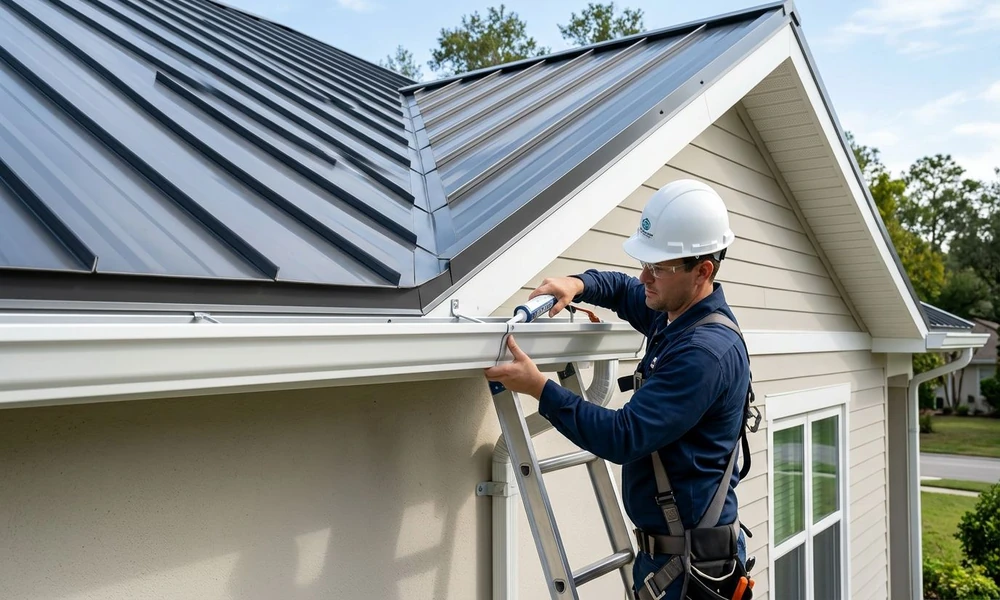
Drive through Mueller, Travis Heights or the newer streets out past Dripping Springs and you will see standing seam metal roofs on almost every block. They suit the heat, they shed hail better than many shingles, and they fit the modern farmhouse look that has taken over Central Texas. What few homeowners think about until the first big storm is that a metal roof sends water into the gutter in a very different way than asphalt does.
Shingles have a rough, gritty surface that slows runoff as it travels down the slope. Painted steel has almost no friction. In a heavy downpour, water leaves the panel edge faster and with more forward push, and that changes how big the gutter should be, where it should sit and what should hold it up.
Anyone planning gutter installation in Autin gutter installation in Autin on a metal roofed house will find that the details matter more than the price per foot. A Temple based, veteran-owned company with more than 870 Google reviews forms seamless aluminum gutters on site for homes from Austin north through Georgetown, Killeen and Waco. It offers more than a dozen baked enamel colors to match roof panels and extends discounts to veterans and first responders. The real question, though, is what any installer should be doing differently once the roof overhead is metal.
Water That Leaves the Roof in a Hurry
On a shingle roof, rain mostly drops into the gutter. On a metal roof, it can shoot past it. Installers call this overshooting, and it is most common on steep pitches, long roof planes and valleys, where water from two slopes merges into one fast stream.
The usual fixes start with capacity. A 6 inch K style gutter holds noticeably more water than a 5 inch one, and the wider opening gives fast runoff a bigger target. Many installers also add a splash guard at valley outlets. This is a short raised piece of metal at the front lip that knocks the stream back into the trough.
Getting the Overhang Right
Where the panel edge ends relative to the gutter matters as much as gutter size. If the panels stop short of the trough, water can curl back under the edge and run down the fascia. If they reach too far out, the stream flies over the front lip.
Most metal roof manufacturers call for the panels to extend roughly an inch or so past the eave trim. The gutter is then set so the roof edge sits over the back half of the trough, not the front. The gutter also has to be hung low enough to stay out of the panels’ way, because metal panels expand and contract with every swing between a cool morning and a hot afternoon. A gutter jammed tight against them can pin that movement and loosen fasteners over time.
Holding the Gutter Without Touching the Panels
This is where metal roofs and shingle roofs part ways most clearly. On a shingle roof, a hanger strap can be slipped under the shingles and nailed to the deck. On standing seam metal, screwing through a panel creates a leak point and can void the roofing warranty.
On a New Roof
When the roof and gutters go on together, the cleanest approach is to set gutter straps or hangers before the panels are installed. That way, nothing pierces the finished roof. This takes coordination between the roofer and the gutter crew, and it is one of the strongest reasons to schedule both trades as one project.
On an Existing Roof
For a retrofit, hidden hangers screwed into the fascia board do the work. They go in about every two feet, and more closely along the eaves under valleys. The fascia itself has to be sound. Rotted boards should be replaced before any gutter goes up, or the new system will pull away under its first full load of water.
Metals That Do Not Get Along
Most metal roofs in Austin are Galvalume or painted Galvalume steel, which is coated with an aluminum and zinc alloy. That coating reacts badly to certain other metals when water connects them. The Metal Construction Association’s bulletin on dissimilar metal corrosion is a good primer on why. Copper is the main offender, and copper runoff can damage a roof even without direct contact.
For gutters on a metal roofed home, that boils down to a few practical points.
- Aluminum gutters are generally compatible with Galvalume and painted steel roofs, which is one reason they are the default choice.
- Copper gutters look beautiful, but they should not sit below or touch a Galvalume roof.
- AC condensate lines and other copper sources should not drip onto the roof or into aluminum gutters.
- Fasteners should be compatible with both the gutter and the roof, so that a stray screw does not become the start of a rust spot.
Homes Without Much Fascia
A lot of contemporary Austin houses have thin eaves, flush roof edges or exposed rafter tails instead of a deep fascia board. These designs look sharp, but they leave very little surface to hang a standard gutter on.
Installers have a few ways around this. Half round gutters on brackets fastened to rafter tails suit farmhouse and craftsman styles. Roof mounted straps set under the panels during roofing work well on flush eaves. On architect designed homes, a built in box gutter is sometimes planned into the roof edge itself. Each choice affects the look of the house, so it is worth deciding early rather than after the roof is already finished.
Matching the Look
Metal roofs come in bold colors, and a mismatched gutter stands out more against them than against shingles. Common panel shades like charcoal, matte black, light bronze and gray have close matches in baked enamel gutter coil. Some homeowners prefer gutters that match the trim instead, so the roofline reads as one clean band. Either approach works, as long as the downspouts follow the same color plan.
Ice, Leaves and Hail
Austin does not see much snow, but the February freezes of recent years showed what happens when ice sheets slide off a metal roof all at once. A sheet of ice can bend a gutter or tear hangers loose. Where ice is a concern above walkways or entrances, snow guards on the roof are worth discussing.
Leaves also slide off metal faster, so live oak debris tends to pile up in gutters rather than on the roof. A guard designed for high flow keeps the trough open without slowing the water down. Hail can dent aluminum gutters, and thicker .032 gauge coil holds up better than thinner stock.
Sequencing a Reroof
If a metal roof is coming in the next few years, it usually makes sense to time new gutters with it. Old gutters have to come down for the roofers anyway, and hangers can be placed before the panels go on. It also lets one plan cover the overhang, flashing and drip edge together. Installing gutters first and the roof later often means taking the gutters down and rehanging them, which adds cost and risks scratching the finish.
A metal roof can last for decades, and the gutters below it should be planned to keep up with it. When the size, overhang, hangers and metals are chosen with the roof in mind, the water from even a fierce Texas storm lands where it belongs, in the trough and out through the downspouts.